Wednesday, July 10, 2013

Tuned City Brussels 2013 - bx in action

fmwalks/bx was the title of a series of sonic interventions in the city of Brussels, during the Tuned City festival. It was also a proof of concept, of how the system can be applied to places, what forms and formats would be possible and challenging. It turned out to be useful to have a wireless microfone available. People picked up the wireless for browsing around, into the nearby area, so I could mix the soundscape around the bx with the details and findings of their walking performance, along with other intersections with the radio aporee ::: maps etc. All walks and interventions were live broadcasted on the radio aporee ::: stream and occasionally into the FM space. By using a sort of virtual recorder on aporee, i could record and archive some of these sessions by simply touching a button on my mobile phone. Listen to some of the sonic traces on archive.org

preparing the bx at QO2. photo by Carsten Stabenow

 
Brussels, Botanique, spontaneous interferences with Christina Kubisch's Electrical Walks
Botanique, airwaves

Parvais de Saint Gilles, Saturday market walks
city places - radio spaces ::: Chausée de Waterloo, Galerie Rivoli
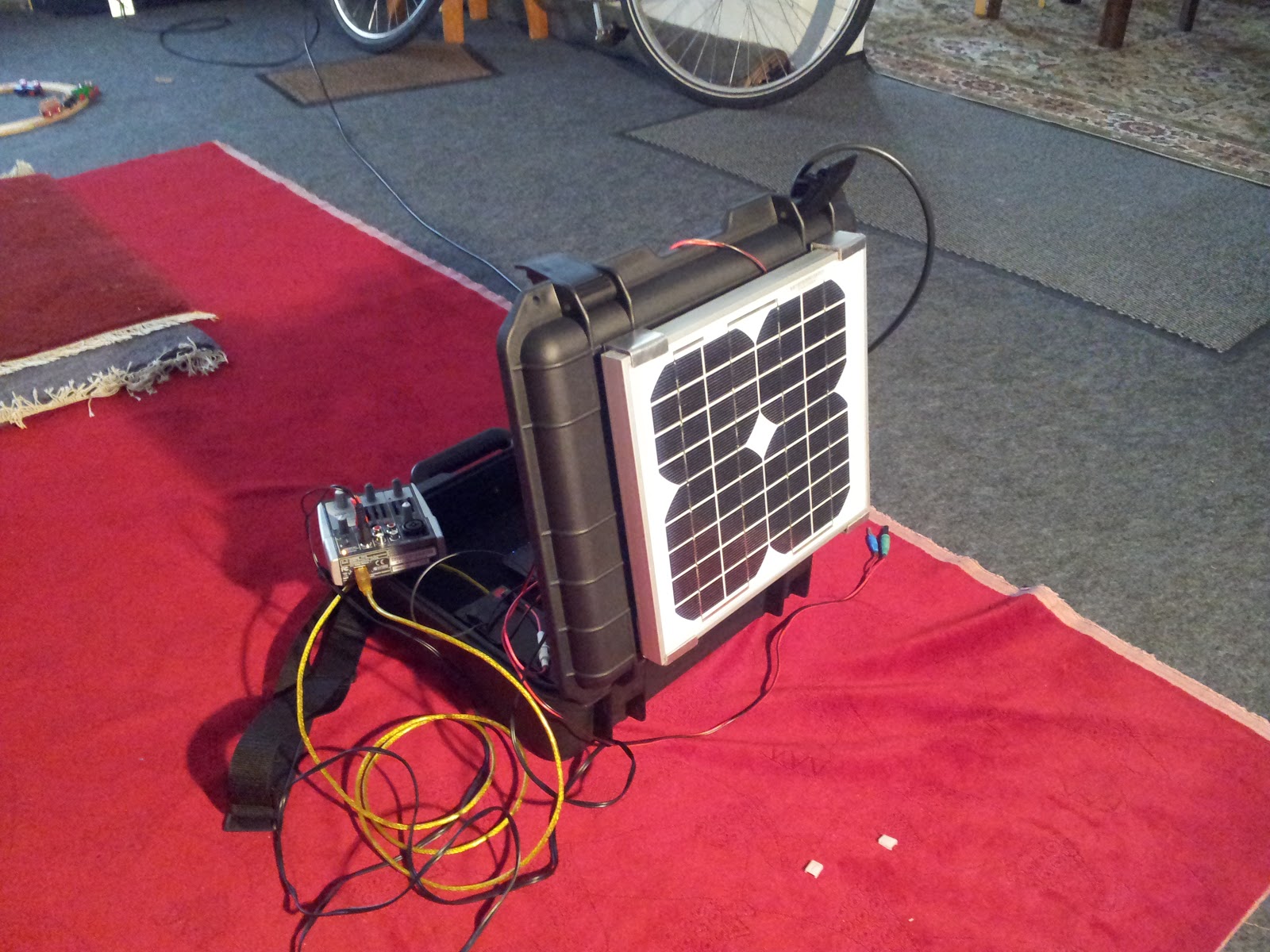
Haren, finally some sun, charging the box (photo by C.Stabenow)


Thursday, June 13, 2013

radio aporee ::: Tuned City Brussels 2013


Over recent years, and thanks to a broad community of artists, phonographers and individuals working with sound and field recording, the radio aporee ecosystem has collected and developed both an extensive body of sound as well as tools for artistic practices and research in the field.
In addition to aspects of collecting, archiving and sound-mapping, the radio aporee platform also invokes experiments at the boundaries of different media, and public space. Within this notion, radio is both a technology in transition and a narrative. It constitutes a field whose qualities are connectivity, contiguity and exchange. Within this, concepts of transmitter/receiver and performer/listener may become transparent and reversible.

During Tuned City Brussels, I will accompany the course of the festival with the experimental radio device bx (bROADCAST BOx), a hybrid assembly of tools and techniques for entering and exploring different media spaces more or less simultaneously. The bx is an advancement of the previous concept of fmwalks, a setup combining performative city walks and mobile FM transmitting. It creates a link between the radio aporee soundmap of Brussels, recent recordings from actual city surroundings and live activities at various festival venues. It delivers a daily sound stream in between documentation and artistic radio practice, embedded into the city’s urban atmospheres.

According to its notion of an interface, fmwalks/bx is open for participation. It encourages engagement and collaboration with the other Tuned City projects and artists. During festival hours, transmissions can be received on http://radio.aporee.org.

If you are interested in collaboration during the festival (26-30 June) – please register!

Thursday, May 23, 2013

A100

Sonic exploration of areas affected by the planned federal motorway A100, Berlin. See also http://de.wikipedia.org/wiki/Bundesautobahn_100 (in german). A project by Henrik Schröder and Udo Noll. Since 2008, Henrik and I have visited this area between Neukölln and Treptow, Berlin, regularly.
In May 2013, the A100 works officially started with a symbolic act. That was the reason for me to visit the allotment area around Beermannstr. / Kieffholzstr., a lovely garden plot, partly abandoned, which will loose ground completely when the Autobahn approaches.


Check the soundmap of the A100 

bx @ Emitter Micro Festival, ausland, Berlin

for the EmitterMicro festival and with my experimental radio device "bx", i've played with
different media spaces more or less simultaneously, utilizing the sonic ecosystem of radio aporee and field recordings from the nearby city surroundings.


The yard at ausland was just perfect. some benches, dry latches, an old table, and a nice atmosphere:


but then a heavy rain started. friendly audience protected me, but i had to cancel the show after 20 minutes.

picture by emitter micro

Peter Cusack, Louis Laurain and Kim Cascone continued with nice performances and lectures in the dry basement.

Sunday, December 2, 2012

sound, place and global reach

i was pointed to a video by a radio aporee contributor a few days ago:
Piccolo Teatro Sonoro: A sonic statement by Binaural/Nodar

it emphasizes on the formula "local not global", and "tries to defend the  problematization of the possibilities for a regionalist [...] approach",  against "globalized tendencies, such as world sound maps". since there are not so many world sound maps around, i somehow took it personal (well, not so seriously...) and wrote these lines (not only) as  a response.
 
first, i perfectly follow the ideas and concepts of locality and region,  i think nodar does great work here, from what i know from friends who have been there, from collegues and (global...) media. however, to simply put it in opposition to practises related to mapping, archiving and sharing of sound recordings, misses the point a bit. at least i think so, and i can only talk for myself here of course, maybe also from conversations  with friends, collegues and contributors. so this is rather a private view on a project i love, skip here if you expect theory.

the whole aporee soundmap thing began as a reaction to the lack and  loss of sense of place, the personal experience of decreasing sensitivity for things "in between", the absence of resonance in my relationship to the surrounding world.

so, the first sound map draft was the result of bad mood... (and of course  some interests, skills, backgrounds from way older works between art,  science, media etc.). sound as such was central and essential, since  it has always been a path or access to space and place.

it wasn't planned as a global or even public project, i shared it with friends, we experimented with phones calls, found material, location/field recordings, also the possibility of narratives in between media and real surroundings.  well, friends told their friends about it, and when the first recording from Asia arrived, it became "world-wide". there's still no login needed for participation, it doesn't have these fancy "social" features of actual "crowd-sourced" commercial platforms of any sort, which only work for turnover and nothing else, no matter how useful and convenient they are, and, btw, establish new models of labour and exploitation which i find at least questionable. the radio aporee platform is a one man show, "hand-made", self-financed, and has never received any funding. didn't apply though...

focus shifted soon towards sounds from places and situations, field recordings and such, as "raw" as possible. editing, composition, mixing etc. obviously weakend the experience of presence, intensity and the listening experience, while looking at a geographic map. (i admit, web sites and interfaces suck over time, google maps too. i don't like it but there's no alternative so far on that scale and detail). 

that's what it's also about: long time "exposition" of places, deep listening,  connectivity, evocation of Proustian moments of complex perception... that's one side, on the other there are people who probably have spent 1000s of  hours at real places listening, recording, later preparing and uploading  the material for documentation and sharing with others. sure there are a quite lot of sounds captured en passant, in touristic mode when travelling around with small pocket recorders. and these are often great, real situations, ephemeral ambiences, moments at places. many others are phonography, field recordings in the best sense, a form of art, just perfect. i've listened to almost all of them, and 10000+ listeners do so every month since years.

the nodar video suggests that the soundmap "engulfs" individual approaches and discredits (or enforces the recogniton of) the recordist/contributor as a indefatigable sound tourist. i think that's wrong, not sure where this idea comes from, surely not from listening to the actual recordings. i understand that some feel uncomfortable with the amount of contributions, in all their different qualities, the flattening perspective of the map maybe, and insist on distinction, for whatever reason. zoom in, go to the details, listen to the indivdual sounds, that  may change your perspective.

my observations are different anyway. there are countless examples of deep and intense examination of spaces and places by sound. some are visiting the ever same place for  years now, documenting subtle changes in their local surrounding, others do extended  research, individually, in groups or educational contexts, of neighbourhoods, areas,  regions and subjects of interest, and so on. they use the site for their own projects and visibility. not to mention the friendships, encounters, beers and coffee had, the permanent exchange, collaborations and even the living some are able to generate out of it. that's quite the opposite of "global" or globalisation. BUT: it has a global reach, that makes it  possible and interesting, we're exchanging ears and sharing experiences from otherwise  mostly unreachable places. for me it re-enabled and activated a formerly lost or inaccessible space. that's in the very sense of the initial idea of the aporee soundmap. glad about it. stay tuned.

Thursday, October 11, 2012

bx - bROADCAST BOx

so, as announced, here's the first result from recent bricolage works... : the bx!
it's a mobile radio device for entering, exploring and playing with different media spaces more or less simultaneously, at almost any location.

some facts and figures:
  • a 0-15W stereo FM transmitter can enter the whole FM radio band, 88-108MHz
  • the sender is connected to a small USB 5channel mixer/soundcard connected to an eee pc, equipped with various audio and streaming software.
  • the main mix (2 stereo lines, 1 mic line, and computer's audio sum) can be broadcasted to FM and a (e.g. radio aporee) streaming server at the same time (wifi or 3G network given).
  • optionally, the telephone network and radio aporee mobile interfaces (app etc.) can mix into the stream/broadcast too. things to do here...
  • the unit is powered by a 10Ah battery (+ netbook accu) at 5V/USB and 12V, optionally supported by a 10W solar charching unit if weather conditions are fine. that should give some hours of independant outdoor operation...
  • the only thing that doesn't fit into the box for now is the FM antenna. working on...
some pictures:

bx - transport mode
bx - full operation mode
bx - removable solar unit attached
bx - detail view: FM, netbook streamer, power supply


next step is to fine tune the box, set audio and signal levels, and test its range in various conditions (antenna on the roof, in the field, on a hill, etc.). a set of wireless microphones would fit the concept perfectly... more to come, stay tuned...

Friday, September 7, 2012

radio activity


I've recently focussed again on the radio aspects of radio aporee. within the last years, it has continuously played recordings from its global soundmap project. however, it has now turned into an adaptive/reactive/sensorial stream that may (or may not...) recognise and react to events and acivity, e.g. new sound uploads, listeners tuning in, mobile app activity, live input, phone calls, emails etc. it's an ongoing experiment to explore extended concepts and practises related to sound/art and radio, tune in with your favourite player or open on the web.

not everything is working yet, but while listening for many hours during recent weeks, i quite often had the exciting experience of what i'd call radio space:  ephemeral sonic narratives formed by chance and whatever activities, a connectivity cross media and geography, and an intriguing sense of presence and place. of course, all that wouldn't be possible without the many great contributions to the aporee soundmap.

Further, within these radio acticities, i've started working on a piece called bx, broadcast box. it's a portable box containing an 15W FM stereo transmitter, a small 5-channel USB mixer/soundcard, optionally a computer with WIFI and 3G networking, and an energy unit consisting of a 10 or 20W solar panel, control unit and a 12V/10Ah battery for powering the whole thing. the bx will be able to
send, receive and mix between the internet and FM airwaves from any location where a network is available. currently i'm sorting the parts, more on that soon, stay tuned...