
radio aporee info, news & announcements
Friday, February 20, 2015
distant readings
distant reading - excerpt of a spontaneous live session on radio aporee, by OR poiesis (Maribor, Slovenia) & unosonic (Berlin, Germany). Sounds and texts were not synchronized nor negotiated in advance, it's more or less a result of moods, atmosphere amd the very moment. to be continued.
The track consists of 2 live sources (OR poiesis and I, from our respective locations) and a background from radio aporee's playlist. So it's actually a toposonic mix of 3 layers. Since we experience up to 30 sec of buffering, i.e. delay between the sending source and its audibility on the radio, it's quite difficult to perform just in time. Anyway, I'd say it works nice.

Sunday, November 23, 2014
Ringo Cafe
 |
| Sanderstr., Berlin, April 2008, |
The sea has passed, to plot is possible, given detachment and a careful angle, all destinations are predictable. And given too, the confidence of distance, strangers may take a hundred neural journeys [...] And even though, on any printed landscape, directions never tell you where to go, maps are an evening comfort to the traveller, a pencil line can quickly take him home.
Some places matter. When they go missing, threads and fragments of ephemeral interwoven biographies may tear away. Without: who knows what's hidden in this word?
a quiet monday, 5.10.2009
public viewing, 20.9.2009
ventilation pipe, men's toilet, 22.11.2014
last coffee, familiar sounds, 22.11.2014
Tuesday, August 12, 2014
colabo radio aporee
Tonight, Tuesday August 12, from 7pm to 6am Berlin time, radio aporee is on air on
senderberlin.org FM 88.4 (Berlin) and 90.7 MHz (Potsdam), and of course online on radio aporee.
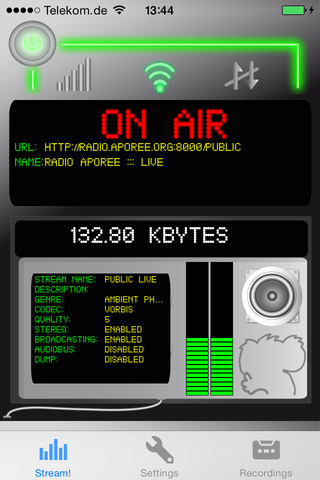

As some already know, the permanent radio of radio aporee plays random selections of sounds from the global map -- unless listeners tune in. then a bunch of "agents" start working backstage, bringing back sounds from listener's locations, scanning open microphones (from the locusonus project and others), creating mixes based on text searches, phones calls etc. pp.
In a way, this radio "listens" to its listeners, their activities, locations, various events, sensors, and so on. recently, "live" has become important, i.e. entering the more or less archive-based stream with ad-hoc performances, sonic interventions from daily situations, or just a few minutes of actual ambience. some are doing that for a few month now, see the log of some past sessions at archive.org (the radio has an archival function which can record a session to archive.org automatically).
although that all is unstable media, and highly experimental, it has proven to work quite nice. so, the idea in mind is a participative radio, created by and shared among interested persons and parties, in between live and archive, sites and situations. it's not about the usual forms and formats of radio production, rather the transient, ephemeral and unexpected. Tune in tonight and get an idea!
senderberlin.org FM 88.4 (Berlin) and 90.7 MHz (Potsdam), and of course online on radio aporee.
As some already know, the permanent radio of radio aporee plays random selections of sounds from the global map -- unless listeners tune in. then a bunch of "agents" start working backstage, bringing back sounds from listener's locations, scanning open microphones (from the locusonus project and others), creating mixes based on text searches, phones calls etc. pp.
In a way, this radio "listens" to its listeners, their activities, locations, various events, sensors, and so on. recently, "live" has become important, i.e. entering the more or less archive-based stream with ad-hoc performances, sonic interventions from daily situations, or just a few minutes of actual ambience. some are doing that for a few month now, see the log of some past sessions at archive.org (the radio has an archival function which can record a session to archive.org automatically).
although that all is unstable media, and highly experimental, it has proven to work quite nice. so, the idea in mind is a participative radio, created by and shared among interested persons and parties, in between live and archive, sites and situations. it's not about the usual forms and formats of radio production, rather the transient, ephemeral and unexpected. Tune in tonight and get an idea!
Wednesday, July 16, 2014
World Listening Day 2014
"Listen To You"
radio aporee participates in the 5th World Listening Day.read more about the WLD at the World Listening Project's website

you are invited to participate, please send your audio recording to radio aporee, and help creating a sonic snapshot of the world, on July 18, 2014:
- you can upload to the radio aporee ::: maps (please tag your recording with WLD 2014 or similar) or directly to the WLD2014 project page on radio aporee (open for upload on July 18)
- please read the instructions on how to upload to the soundmap. let me know if you have problems.
Monday, May 12, 2014
mobile streaming continued
a bit of tech info today...
while the raspberry PI (see older posts below) is a nice, rather inexpensive and portable solution for mobile radio streaming, it has shown some problems during daily use. first, it sometimes crashes for no obvious reason, leaving the system in a unusable state. may have been a problem of the SD-card in use, not sure. anyway, it's good to backup a working configuration and have a second card at hand, otherwise the session may be over. second, since it has no display or keyboard, and has to be controlled from a phone app over the internet, it can be quite confusing because of drops and delays, depending on the available network. I think a PI based setup is fine for semi-/stationary audio broadcasts, but for true mobile performances, something else is needed.
so, I've digged into the matter a bit deeper, and this is the best option I've found so far:
it's a used iphone 4s, a tascam IXJ2 preamp, and a pair of DIY
microphones based on Primo EM172 capsules. the koalaSan streaming app
has proven to work stable and reliable. the whole thing can be
controlled from the phone's browser, with the radio aporee web app.
while the raspberry PI (see older posts below) is a nice, rather inexpensive and portable solution for mobile radio streaming, it has shown some problems during daily use. first, it sometimes crashes for no obvious reason, leaving the system in a unusable state. may have been a problem of the SD-card in use, not sure. anyway, it's good to backup a working configuration and have a second card at hand, otherwise the session may be over. second, since it has no display or keyboard, and has to be controlled from a phone app over the internet, it can be quite confusing because of drops and delays, depending on the available network. I think a PI based setup is fine for semi-/stationary audio broadcasts, but for true mobile performances, something else is needed.
so, I've digged into the matter a bit deeper, and this is the best option I've found so far:
 |
| studio in a pocket |
 |
| metada editor for live sessions |
 |
| control streaming from html5 web app |
since a while, i'm using it often for short live sessions on radio aporee. I'm quite pleased with the results and overall handling. the connection between phone and preamp is a bit fragile, maybe it'd be better to use a cable or fix it with something.
if you like, you can always find a log of some of the most recent sessions at archive.org.
anyway, now that some of the tech problems are adressed, i'll try to concentrate on what all this is meant for. new radio... stay tuned...
Friday, March 21, 2014
walking in split electro-acoustic realities
Electrical Walks by Christina Kubisch is a work in progress. It is a public walk with
special, sensitive wireless headphones by which the acoustic qualities
of aboveground and underground electromagnetic fields become audible.
During the Audiograft Festival, Felicity Ford and I have performed a walk through both the acoustic and electromagnetic realities of Oxford Brooks campus. The signals from Christina's headphones were mixing with the sounds from a microphone, and broadcasted live on radio aporee. It was quite interesting to see if and how our expectations of the hidden electromagnetic/sonic field correlated with the actual site and its audible environment.
Here's a log of our walk, including all glitches, noise, clipping, network drops and stream fallbacks etc., which naturally belongs to the acoustic patina of radio aporee live performances...
electrical walk part 1
electrical walk part2
 |
| electrical walk (photo by Patrick McGinley) |
Here's a log of our walk, including all glitches, noise, clipping, network drops and stream fallbacks etc., which naturally belongs to the acoustic patina of radio aporee live performances...
electrical walk part 1
electrical walk part2
Thursday, March 13, 2014
audiograft festival Oxford 12-23 March 2014
I've been at the audiograft festival in Oxford, continuing with my experiments on localized radio, performative broadcasting and affective geographies. During the festival days, i've performed walks, attended meetings and approached situations. This happened more or less spontaneously, so people could tune in to radio aporee at any time to follow the audiograft activities. Many of these sessions have been documented on archive.org, see audiograft live session recordings
 |
| broadcast from an audioHEARth event at an Oxford pub |
broadcast from an audioHEARth event at an Oxford pub
The following two are from the nice Oxford City Market at early afternoon, which i've visited together with Patrick McGinley. Felicity Ford joined us later.
Oxford City market part 1
Oxford City market part 2
Subscribe to:
Posts (Atom)